

When we learn about our ancestors’ and their children’s misdeeds often it is so far back in time that we tend to laugh at them. “So, he was ‘crazy’?” Well, guess it runs in the family!”. Especially with the criminal ancestors we have a tendency to enjoy their escapades and mock them. I did so myself when my great-aunt called and informed me of our ‘criminal Ludvig’ (as he is now referred to). She had found his 11th conviction which gave us a good laugh. Somewhat of a delinquent!
Ludvig was the brother of my great-great-great-grandmother Sophie. They came from an old and distinguished lineage. This family cared about marrying into ‘proper’ families, gaining and maintaining influence and money. The family had proven that pride does come before a fall.
The family lived in Copenhagen and Frederiksberg in 1860-1880s. The story unfolded after the Danish National Archives added a search engine for some of their collection and started indexing (1).
So, we had found our family’s first criminal. It was a big moment and needless to say, I wanted to know more. So I used Copenhagen City Archives’ search engine and focused on police reports form the time period (2). I very soon discovered Ludvig was not the only family member to engage with the police. In fact his father and sister (not my ancestor) appeared in the results and a bigger picture started to form. The facts began to come together and show the people behind the arrests, releases, punishments and convictions. Ludvig was 19 years old when he got his 11th conviction and he had started when he was only 13 years old. He was a common burglar. His father was repeatedly arrested for begging. The sister Fritze was also caught stealing at 14 years old. So, what was the story forming here?
The story about this once prominent family’s fate was getting more and more sad. I wanted to understand what had happened since this is were it ended here.

As mentioned the family lived in Copenhagen and Frederiksberg in 1860-1880s. It was a time where many families lost their income and homes and struggled to survive. Meanwhile stories of gold and ‘the land of opportunities America’ had reached Denmark and many Danes made the voyage in hopes of a better and more stable life than Denmark had to offer then. Those who remained had to keep on fighting while the world was changing. The big cities grew and got more cramped, the industrialisation was well in motion and diseases were a real threat.
This too was evident with the Höhling family. Ernst and Christiane were married in 1858 and in 1860-1869 they had 5 children. Christiane died age 41 in 1872 and left Ernst alone with 5 childring age 2-12 years. Ernst tried to maintain a family home and remarried after 5 months with Christine Dorthea Lorenxen. However, this marriage only lasted a few years. They had to live separated for 13 years until finally getting a divorce in 1883.
On paper Ernst had a nice and solid income supporting his family as; a grocer first, then as manager, commissioner and lastly trading agent – all in the years 1858 to 1893.
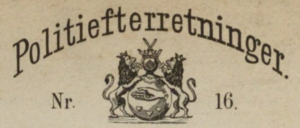
The first signs of problems can be found in the police reports from October 1879 when Fritze was released after 8 days of jail for theft. She was 14 years old and was released into the custody of the city, probably to the poorhouse. The father, Ernst, was at the time a single parent again and at Noerrebrogade 30 with two of his sons according to the 1880 census.
Next thing was in February 1881 when the boys Vilhelm (13y) and Ludvig (11y) were reported missing after not having been home for 3 days.
Next, summarised
– Ernst was arrested 6 times (at least) for begging. He was twice released to the poorhouse.
– Ludvig was arrested for the first time in 1883 and the latest in 1888. The first time he was put in the children’s’ prison ‘Internatet’ on Vesterfaelledvej. In total he had 11 convictions for petty theft.
– Fritze was in 1879 put in facility ‘Ladegården’ and afterwards sendt of to Herlufmagle (approx. 78 km / 48 miles from Copenhagen) – 14 years old and as far as I know, no relatives lived in the area.
The children Simon, Sophie and Vilhelm were never arrested, as far as I know.
So, in spite of Ernst having well-paying jobs on paper, all was not well. In many ways Ernst lost his children. He was in his older years repeatedly homeless, begging for survival and received poor-aid for rent several times because he was too sick to work. That is despite Ernst had many siblings him self, children that had found a stable income and home and in general had a big family.
Ernst died age 62 of pneumonia homeless and alone. The year before he had again been arrested for begging.
Ludvig was released after his 11th sentence in 1889 and left for Rosario, Argentina. This was possibly arranged by Frederiksberg County to ensure they did not have any further dealings with him. This had become a solution for several counties when dealing with delinquents. Ludvig returned to Denmark after about 27 years later. He died in 1934 age 64 and seemed to had lived a normal, crime free life until the end of his days.
Ludvig’s youth is a fascinating story and is a testament of both intellect and a lack of a stable family base. His story will be unfolded further in another article. Here I will dive into court-documents, prison logs and other relevant goodies from the Copenhagen archives. Ernst’s story is also an interesting one that I will also dedicate an article to later on. Here I will show how much information the Copenhagen City Archives can other to shine some light on an ancestors life.
This story about my criminal ancestor in the Höhling family is an example of how we do not always get the full story when just looking at the most common genealogy sources. We need look at many different sources in order to get the full picture. Even then, it is still an educated guess. In this family there are no remaining letters, journals, bible, photos, document or even passed down stories, so my conclusions are still just my best guess.
If you are related to the Höhling family feel free to send an email. It is always nice to meet new family members.
1. The Danish National Archives’ search engine can be found here. You can search across applications for war medals; prison logs; conscription registers; and more is being added.
2. The Copenhagen City Archives also has a good search engine for their many indexed sources. You can search across police reports; census lists; dead registers; and much more. Click here to get there.
Both search engines are in Danish only but are easy to navigate, so do not hesitate to try them out. Both search engines adds new sources often. It is worth the time to search your ancestors names at least once a year and see if maybe something new shows up. Who knows, maybe you have a criminal in your family tree as well?